Ian Manuel
Just MercyIan Manuel’s story traces the distance between a childhood act of violence and the adult punishment imposed for it: at thirteen, he was sentenced to die in prison, then spent eighteen uninterrupted years in solitary confinement. The confinement deepened his despair, but it did not erase his capacity to learn, write, apologize, and form relationships; after his sentence was challenged, he was released and began a life beyond prison.
Crime, Sentence, and Confinement
In 1990, Manuel and two older boys attempted to rob a couple dining out in Tampa, Florida. When Debbie Baigre resisted, Manuel shot her with a handgun the older boys had given him. The bullet passed through her cheek, shattered several teeth, and severely damaged her jaw. All three boys were arrested and charged with armed robbery and attempted homicide.
Manuel’s appointed lawyer urged him to plead guilty and assured him he would receive a fifteen-year sentence. The lawyer did not realize that two charges carried possible life-without-parole sentences. The judge accepted the plea and imposed life without parole. In sentencing a thirteen-year-old, the judge faulted Manuel for living on the streets, lacking good parental supervision, and having prior arrests for shoplifting and minor property crimes. Rather than treating those circumstances as evidence of childhood vulnerability, the proceeding used them to condemn him.
Manuel was sent to Apalachee Correctional Institution, an adult prison in Florida. At the processing center, staff could not find a uniform small enough for him and cut six inches from the bottom of the smallest trousers. Because juveniles in adult prisons face a heightened risk of sexual assault, staff placed him in solitary confinement. The cell was a concrete box about the size of a walk-in closet: meals came through a slot, contact with other prisoners was absent, and physical proximity to another person was prohibited. He received three showers a week and limited exercise in a small caged area. Refusing an order, shouting, hurting himself, or complaining could bring further time in isolation; for some infractions, he was made to sleep on the concrete floor without a mattress.
Inside that regime, Manuel became what he called a cutter, using sharp objects from his food tray to cut his wrists and arms and watch himself bleed. His mental health deteriorated, and he attempted suicide several times. Each episode of self-harm or acting out could extend the isolation that had helped precipitate it. He remained in uninterrupted solitary confinement for eighteen years, a punishment begun when he was still a child and prolonged through the very distress it produced.
Apology, Correspondence, and Intellectual Life
The isolation sharply restricted Manuel’s contact with other people, but a monthly phone call gave him one fragile route beyond the cell. Soon after arriving in prison, on Christmas Eve 1992, he used that call to reach Debbie Baigre, the woman he had shot. He poured out an emotional apology and expressed deep regret. Baigre was stunned to hear from the boy who had wounded her, yet moved by his call. She had recovered physically and was pursuing her ambitions as a bodybuilder while starting a women’s health magazine; the shooting had not derailed the life she was determined to build. Their unexpected first conversation grew into regular correspondence.
That connection mattered in part because Manuel had been neglected before the crime, left to wander the streets with little family support. In solitary, he met few prisoners or correctional staff, and as he sank deeper into despair, Baigre became one of the few people encouraging him to remain strong. After years of communicating with him, she wrote to the judge who had sentenced him, arguing that the punishment was too harsh and the conditions of confinement inhumane. She also approached prison officials and spoke to the press. Her position held both facts in view: Manuel’s crime had been destructive and reckless, and the treatment of a thirteen-year-old through prolonged isolation was, in her view, mean and irresponsible. Her advocacy did not erase the harm she had suffered; it made her a witness to the punishment that followed it.
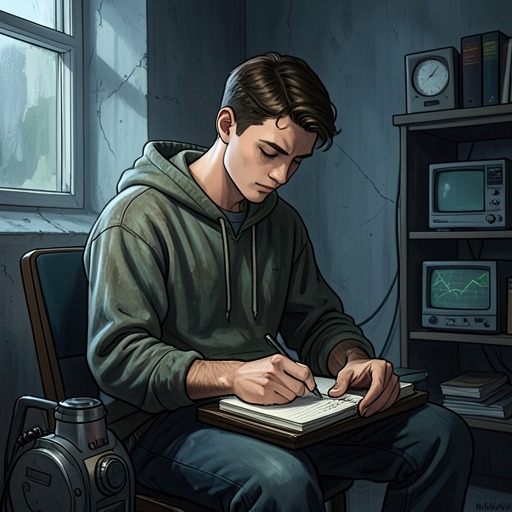
Manuel’s letters and poems disclosed an intellectual life that the concrete cell could not contain. He educated himself, read hundreds of books, and wrote poetry and short stories marked by an eager, robust intellect. He sent Bryan Stevenson dozens of letters and poems; after Stevenson returned from travel, letters from Manuel would often be waiting at the office. Sometimes a letter enclosed a small, wrinkled scrap of paper that opened into a poem, with titles including “Uncried Tears,” “Tied Up with Words,” “The Unforgiving Minute,” “Silence,” and “Wednesday Ritual.” Their physical form—a folded, crumpled page carried inside a letter—contrasted with the isolation around their author: writing let Manuel address another person and shape experience into language even when ordinary human contact was withheld.
Legal Advocacy and Release
The legal effort to change Manuel’s sentence grew from a constitutional argument about childhood and culpability. After the United States Supreme Court barred the death penalty for juveniles in 2005, Bryan Stevenson and the Equal Justice Initiative considered whether the same recognition of developmental differences could challenge life without parole for children. They filed such challenges in several states, including Florida, where Manuel remained in solitary confinement. The cases placed his sentence within a broader question: whether a child could be condemned to spend an entire life in prison without any meaningful chance of release.
On May 17, 2010, the Supreme Court held that life without parole for children convicted of non-homicide crimes was cruel and unusual punishment. The ruling made Manuel eligible for relief and for a reduced sentence that offered a meaningful opportunity for release. It was the Court’s first categorical prohibition of a punishment other than the death penalty, but the new rule did not itself open prison doors. Judges and prosecutors resisted applying the decision, and some courts imposed sentences that approached a person’s life expectancy rather than creating a realistic possibility of freedom. In California, a judge gave Antonio Nuñez 175 years after replacing his life-without-parole sentence; Manuel’s case also met resistance. The legal victory therefore began another struggle over what an opportunity for release would mean in practice.
In November 2016, Florida finally released Manuel, after he had been imprisoned since age thirteen and spent most of that time in solitary confinement. Debbie Baigre, the woman he had shot, embraced him upon his release. They had dinner together before he traveled to Montgomery and joined the Equal Justice Initiative’s reentry program. The reunion brought their years of correspondence into the same physical space: the woman who had received his apology was there to welcome him out of prison, without the encounter diminishing the seriousness of the shooting or the years of punishment that followed it.
Manuel’s return to public life also carried his writing beyond the letters and poems he had sent from confinement. A few months after his release, he performed one of his poems at the Equal Justice Initiative’s annual event in New York City; he now writes and performs spoken-word poetry. His trajectory from a child sentenced to die in prison, through eighteen years of isolation, to a released poet does not undo the injury to Baigre or the violence of the crime. It does show what the sentence had denied: a future in which Manuel could live outside the cell, continue to write, and meet the person he had harmed as someone capable of accountability and change.
A Wider Change in the Meaning of Childhood
Two years after the 2010 ruling that opened a path to relief for children convicted of non-homicide crimes, the Supreme Court barred mandatory life-without-parole sentences for children convicted of homicide. The decision in Evan Miller’s case and Kuntrell Jackson’s case meant that no child accused of any crime could again be automatically sentenced to die in prison. More than two thousand people sentenced to life without parole for crimes committed as children became potentially eligible for relief, although prosecutors resisted applying the ruling retroactively. For Manuel, whose sentence had already been challenged under the earlier decision, this broader change placed his case within a national reconsideration of whether childhood could be treated as irrelevant at sentencing.
That change did not guarantee prompt release or an easy return to ordinary life. EJI created a reentry program for clients who had spent many years in prison after being incarcerated as children, offering housing, job training, life-skills support, and counseling. Manuel joined the program after his release, linking the legal recognition of a possible future to practical help in beginning one. His case thus belongs both to the history of an extreme sentence imposed on a thirteen-year-old and to the slower work of making release meaningful after years in isolation.